For distributors and traders running their books in Tally
Your orders arrive by email. Your books live in Tally. Nothing joins them.
Blitz Docket reads every purchase order that reaches your inbox — PDF, Word, spreadsheet or a photo of a printout — matches each line against your own catalogue, and tells you what has actually been dispatched against it.
The mail
A purchase order lands in the sales inbox, in whatever format the customer's system produces.
The document
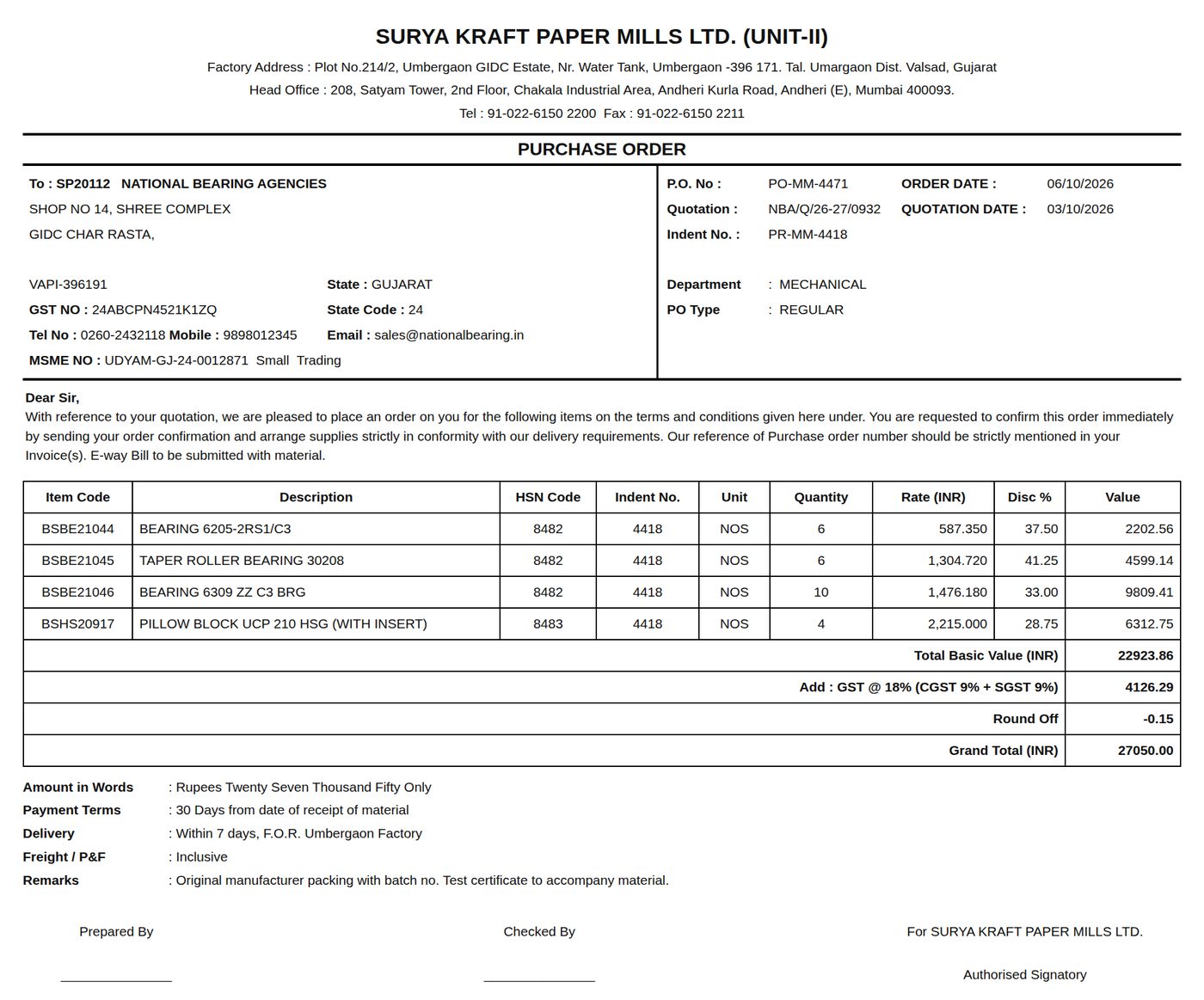
Header, party, GSTIN, delivery site and every line item, taken off the document as printed.
Your catalogue
Each line resolved to a part you actually stock — or listed as a gap, never guessed at.
Tally invoices
Invoices traced back to the order they belong to, line by line, so dispatch state is a fact.
Follow one order through it.
The four steps above, opened up. Each one starts with how it goes wrong at a Tally distributor today, then shows what Blitz Docket puts on screen instead.
The order is already a file, and still gets typed in
It came as a PDF, a spreadsheet or a photograph of a printout — digital the whole way — and someone still reads it off one screen and types it into another. The data was never missing. It was just never machine-readable at the moment it mattered.
Every attachment in the sales inbox — PDF, Word, Excel or a phone photo — is read the moment it lands and becomes an order record.
→ the document lands, the order existsA GSTIN read one character wrong
24AACCR8735L1ZO is fifteen characters, correct in shape, and cannot exist — a letter O where the check digit needs a zero. Filed under it, an order belongs to a company that does not exist.
Header, party, delivery site and every line come off the document as printed, and the GSTIN is checked on its own check digit before anything is filed under it.
→ the registration is checked, not just countedOne part, written five ways — and only one person knows them all
The buyer's spelling, the accountant's and yours never agree. Exact matching finds none of them; tolerant matching finds the wrong bearing. Which customer means which part lives in one person's head, so the desk stops when they are on leave.
Each line resolves against your catalogue with your brands, synonyms and noise words. What each customer calls a part is recorded once. Anything it cannot place goes on a worklist — never a near-enough guess.
→ their words resolve to your partFast movers go out, slow movers follow, nothing tracks the rest
One order becomes three deliveries over six weeks. On a spreadsheet a part-shipped order is indistinguishable from a finished one, so the gap surfaces as a phone call from the customer.
Invoices from your Tally export are traced back to their order line by line, so every order reads Fully, Part or Not Dispatched — and says exactly what is still owed.
→ every line says what is still owedThe answer is somewhere in a mailbox
A customer wants the PO against an invoice from March. Your accountant flags a tax mismatch on one line. Answering either means searching mail, folders and someone's downloads until it turns up.
Every order keeps the document it arrived on, the party it came from and the invoices raised against it. One search by party, PO number, part or invoice.
→ one order, one record, one searchPO-MM-4471.pdf · 09:12 Order created · 4 lines
order sheet oct.xlsx · 09:40 Order created · 11 lines
IMG_2231.jpg (photo of printout) · 10:05 Reading…
Send a fortnight of real POs and one Tally export.
You'll see what it read, what it matched, and exactly what it couldn't.
Every PO typed by hand is minutes. Every month, that's a person.
Move the sliders to your own numbers.
Two of us used to spend the morning keying in orders. Now one person checks the exceptions, and the book is current before I reach the office.
At month end I would open twenty mails to tie one invoice to its order. Now the order already says which invoices it was billed on, and what is still owed.
What it does, and what it leaves alone.
Your data stays yours. Pakka.
Your orders, customers and prices are your business. We use them for one thing only — keeping your order book straight.
See it against your own orders.
The fastest way to judge it is a fortnight of your real purchase orders and one Tally export. You will see what it read, what it matched, and — more usefully — exactly what it could not.
Book a walkthrough